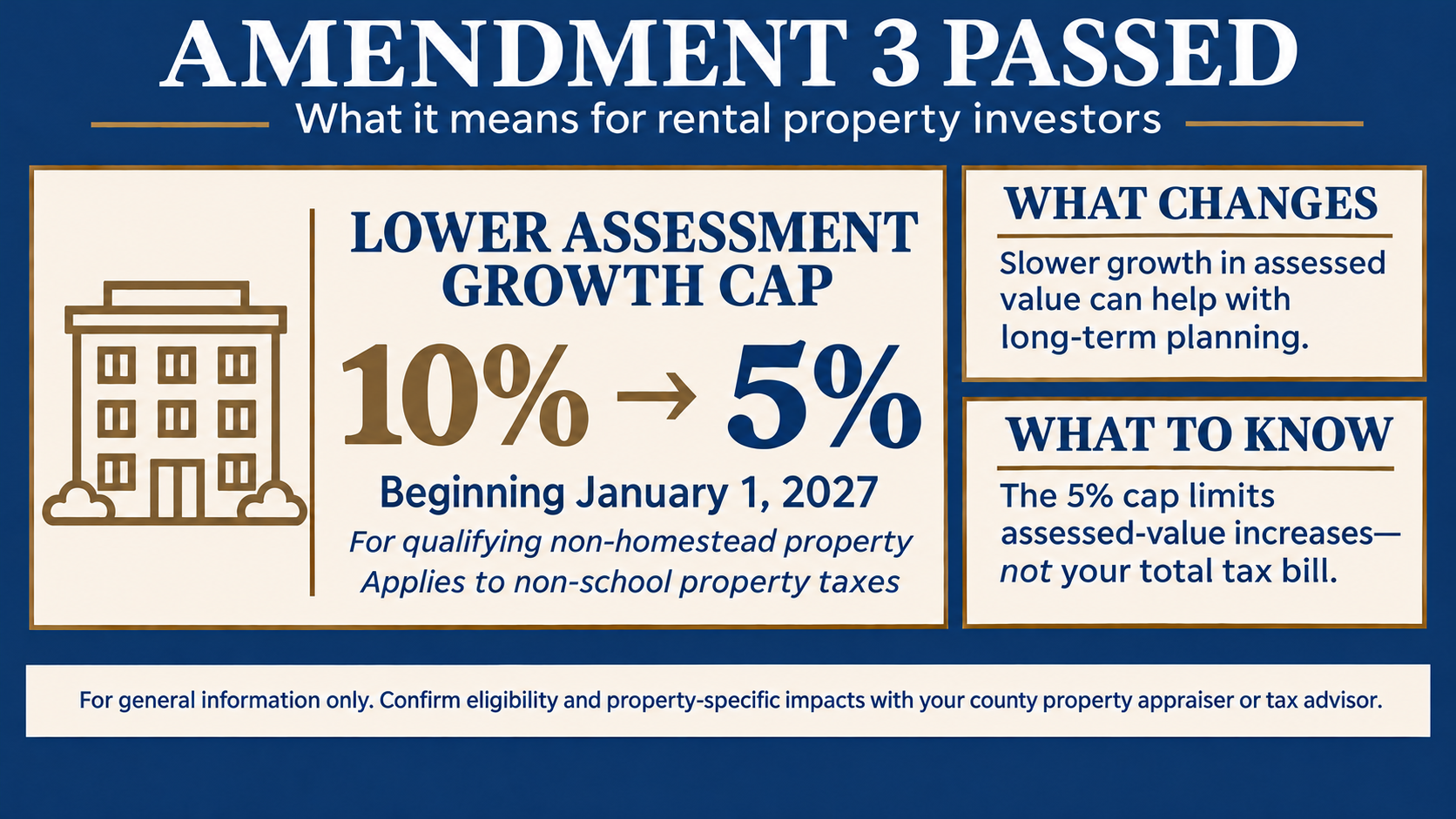
Florida voters approved Amendment 3 on November 3, 2026, bringing changes to the state’s property tax system.
For rental property investors, the key change is a lower annual cap on assessed-value increases for qualifying non-homestead properties. Beginning January 1, 2027, that cap drops from 10% to 5% for non-school property taxes.
That can help with long-term expense planning, but understanding what the cap actually limits is essential.
What changes for rental properties?
Rental properties generally do not qualify for the homestead exemption available to eligible owner-occupied primary residences. Instead, the investor-focused provision of Amendment 3 reduces the annual assessment-growth cap for qualifying non-homestead property.
The lower cap can slow growth in the assessed value used to calculate non-school property taxes when property values rise. It does not automatically reduce your existing assessed value or guarantee a lower tax bill.
A 5% assessment cap is not a 5% tax-bill cap
Your property’s assessed value is one part of the tax calculation. Local tax rates, school taxes, and other assessments or charges also affect the amount you pay.
For example, assume a rental has a prior-year assessed value of $200,000 for non-school taxes. With a full capped increase—and no reassessment event or other adjustment—the comparison would be:
• Under a 10% cap: $220,000.
• Under a 5% cap: $210,000.
That is a $10,000 difference in assessed value under those assumptions. It is not $10,000 in tax savings. The dollar impact depends on the applicable tax rates and the property’s circumstances.
School district taxes are outside this assessment limitation, so investors should continue reviewing the entire tax bill.
Buying a rental? Do not rely on the seller’s tax bill
A lower assessment cap does not mean a buyer inherits the seller’s tax situation.
Under Florida’s existing assessment rules, a change of ownership can trigger reassessment. Improvements can also affect assessed value.
Before purchasing, obtain a property-specific estimate from the county property appraiser and confirm how the transaction may affect future taxes. Using the seller’s current bill without accounting for reassessment can make projected cash flow look stronger than it will be after closing.
What should Jacksonville investors do now?
As you prepare your rental property budget:
• Review assessed value, taxable value, and the separate charges on your current tax bill.
• Confirm how the new limitation applies to each property.
• Estimate taxes after a purchase or planned improvements.
• Keep reserves for taxes, insurance, repairs, and other operating expenses.
A lower assessment-growth cap may help moderate one expense over time. It should be part of your planning, alongside realistic rent projections, vacancy allowances, maintenance, and capital improvements.
Keep the focus on the whole investment
At Thirdstone Properties, we look beyond monthly rent to help owners understand how their properties are performing.
If you own a Jacksonville rental or are considering your next investment, contact our team to discuss rental potential, operating expenses, and property management.
*For general information only. Confirm eligibility and property-specific impacts with your county property appraiser or tax advisor.*
Sources
Florida Division of Elections — Amendment 3: Increased Homestead Exemption; Lower Cap on Increases in Non-Homestead Property Assessments. Official ballot summary and amendment information.
Florida Senate — CS/HJR 1-F (2026) Legislative Summary. Overview of the assessment-cap reduction and other amendment provisions.
Florida Legislature — CS/HJR 1-F, Enrolled Amendment Text. Full amendment language, including the January 1, 2027 effective date.
Florida Statutes §193.1554 — Assessment of Nonhomestead Residential Property. Existing rules governing reassessment after ownership changes and improvements for residential properties containing nine or fewer dwelling units.
Published November 5, 2026. The 2026 statute linked above describes existing assessment procedures; its displayed 10% cap reflects the rule before Amendment 3 takes effect.